Why Your Workout Performance Shifts So Much Across Your Cycle (It's Not in Your Head)
Quick Answer: Estrogen and progesterone fluctuations across your cycle genuinely affect strength, endurance, and recovery capacity — many people find higher-intensity training easier in the first half of their cycle (post-period through ovulation) and benefit from slightly reduced intensity in the week before their period, when fatigue and joint laxity can both increase.
Same program, same effort, wildly different results week to week — and it’s not inconsistency or lack of discipline. Hormonal fluctuation across your cycle has a real, documented effect on training capacity.
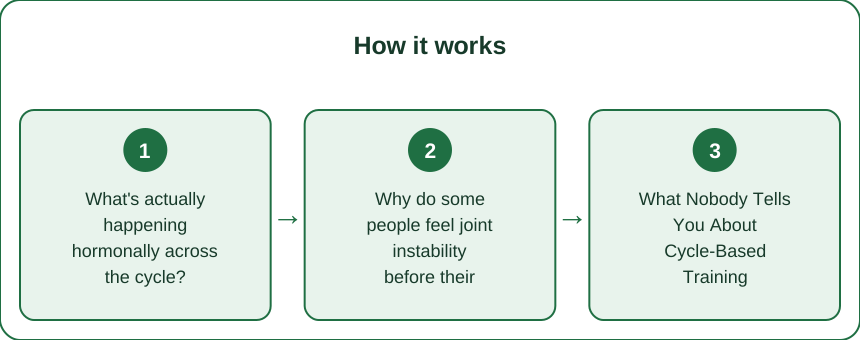
What’s actually happening hormonally across the cycle?
Estrogen rises through the first half of the cycle, peaking around ovulation, and is associated with improved pain tolerance, mood, and in some studies, greater strength output. Progesterone then rises in the second half (luteal phase), which is linked to increased core body temperature, potentially reduced endurance capacity, and greater fluid retention — all of which can make the same workout feel harder.
Why do some people feel joint instability before their period?
Relaxin, a hormone that rises later in the cycle, increases ligament laxity to prepare the body for potential pregnancy — a biological effect, not something specific to pregnancy itself. This can subtly increase injury risk for high-impact or heavy-load movements in the days just before menstruation, which is why extra attention to form and warm-up matters most during this window.
What Nobody Tells You About Cycle-Based Training
Here’s the part most cycle-training content oversimplifies: individual variation in these effects is large — some people notice almost no performance shift across their cycle, while others notice a dramatic one. Rather than assuming a generic ‘phase-based’ plan applies to you exactly, tracking your own perceived effort and performance for 2-3 cycles gives far more useful, personalized data than any generic template.
How should training actually adjust across the cycle, practically?
- Follicular phase (post-period through ovulation): many find this the best window for personal records and higher-intensity work, aligning with rising estrogen and typically improved energy
- Luteal phase (post-ovulation to period): consider slightly reduced intensity or volume if fatigue is noticeably higher, and prioritize extra warm-up time given increased joint laxity risk
- During menstruation itself: capacity varies hugely by individual — some feel fine training normally, others benefit from lighter, shorter sessions; there’s no universal rule here
- Track for a few cycles before changing your program — 2-3 cycles of simple notes (energy, perceived effort, any joint discomfort) beats guessing based on generic advice
FAQ: Cycle and Workout Performance Questions, Answered
Do hormonal birth control users experience the same cycle-performance pattern?
Often less pronounced, since hormonal contraceptives typically suppress the natural estrogen/progesterone fluctuation — patterns vary by contraceptive type and individual.
Is it bad to do heavy strength training during your period?
Not inherently — many people train normally throughout their period; the individual variation point above matters most here, so let your own tracked experience guide intensity, not a blanket rule.
How reliable are fitness apps that offer ‘cycle-synced’ workout plans?
They can be a helpful starting framework, but given how much individual variation exists, treat them as a template to test against your own tracked data rather than a fixed prescription.
TL;DR:
- Estrogen and progesterone fluctuations genuinely affect strength, endurance, and recovery capacity across the cycle
- Rising relaxin before your period increases joint laxity — extra warm-up attention matters most in that window
- Individual variation is large — track your own perceived effort for 2-3 cycles rather than assuming a generic template fits
- Follicular phase often suits higher intensity; luteal phase may benefit from a slight, personalized dial-back
Keep Reading
This article is for general informational and styling purposes only. Fit, sizing, and product availability may vary.