Why the Same Workout Feels Different Across the Month
Quick Answer: Oestrogen and progesterone influence body temperature, fluid balance, substrate use, and perceived effort across the menstrual cycle, and many people notice real differences in how sessions feel. But the effect on actual performance is smaller and more variable than popular cycle-syncing advice suggests — sleep, fuelling, and accumulated training load usually explain more.
One week the session flies. Two weeks later, the identical workout at the identical weights feels like a different sport.
There is genuine physiology here, and there is also a lot of confident advice built on thin evidence. Here is what the picture actually looks like.

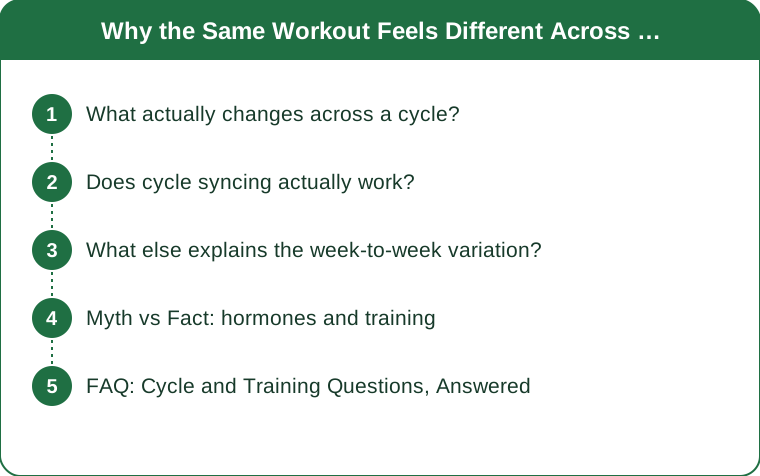
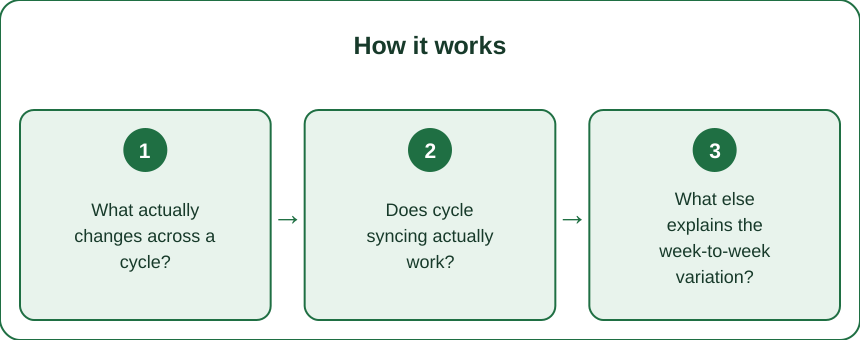
What actually changes across a cycle?
Several things, with different magnitudes.
Core temperature rises by roughly 0.3 to 0.5°C in the luteal phase, after ovulation, under the influence of progesterone. That is a small number with a real consequence: heat tolerance is reduced, so training in warm conditions feels harder and thermoregulatory strain arrives sooner.
Fluid balance shifts, with many people retaining more water in the late luteal phase. This affects body mass, how clothing fits, and joint feel more than it affects performance.
Substrate use changes modestly. Higher oestrogen is associated with somewhat greater fat oxidation and glycogen sparing; progesterone tends to increase protein breakdown. The practical effect for most recreational athletes is small.
Perceived effort frequently rises in the late luteal phase, often alongside disrupted sleep, breast tenderness, and mood changes. This is often the largest real effect — the session is not objectively harder, it feels harder, and feeling harder changes what you actually do in it.
Ligament laxity varies with oestrogen, and there is evidence of higher ACL injury rates around ovulation in some populations, though the effect size and its practical implications remain debated.
Does cycle syncing actually work?
The strong version of it — heavy lifting only in the follicular phase, gentle movement only in the luteal — is not well supported.
Reviews of the research on menstrual cycle phase and exercise performance consistently reach the same conclusion: effects on performance are small on average, highly variable between individuals, and the underlying studies are frequently low quality, often with small samples and poor cycle-phase verification. Some people show clear patterns; many show none.
There are also practical problems. Cycles vary in length and in the timing of ovulation, so a calendar-based plan often misidentifies the phase. Hormonal contraception changes the hormonal profile entirely — a combined pill largely flattens the natural fluctuation — and a large proportion of people use it.
What is genuinely useful is the weaker version: track how you feel and perform, and adjust based on your own data rather than a template. If you consistently find heavy squats miserable in the days before your period, moving them is a sensible individual accommodation. If you notice no pattern, you do not need to manufacture one.
The main harm in the strong version is that it can license reduced training for a week or more each month based on a prediction rather than an observation, which meaningfully reduces annual training volume.

What else explains the week-to-week variation?
Usually more than the cycle does, which is the part cycle-focused advice tends to omit.
Sleep. A single night below your normal duration measurably increases perceived effort and reduces power output. Two or three of them explain almost any bad session.
Accumulated training load. Fatigue from a heavy block expresses on a delay. A hard week produces a poor session ten days later, and it is easy to assign that to whatever phase you happen to be in.
Fuelling. Under-eating relative to training load produces exactly the symptoms people report as luteal-phase heaviness. Notably, energy requirements do rise slightly in the luteal phase — often cited at 5 to 10 percent — so eating the same amount effectively means eating less.
Hydration and heat. Combined with the higher core temperature, a warm gym in late summer is a much bigger variable than most people credit.
Stress and life load. Cortisol affects recovery, sleep, and motivation directly.
The honest approach: track sleep, session quality, and cycle day together for three months. Most people find sleep is the strongest predictor of a bad session, by a wide margin. If a cycle pattern also emerges, you will be able to see it against that background rather than assuming it.
Myth vs Fact: hormones and training
Myth: you should not train hard during your period. Fact: many people perform perfectly well, and some report their best sessions then, as hormone levels are at their lowest and most stable. Symptoms vary enormously. Train to how you feel, not to the date.
Myth: the luteal phase makes you gain fat. Fact: fluid retention changes scale weight by one to two kilograms in many people. It is water and it resolves. Fat gain requires a sustained energy surplus.
Myth: cycle tracking apps can tell you which phase you are in. Fact: they predict based on averages, and prediction error is substantial unless you are also tracking basal temperature or using ovulation tests. A lot of cycle-syncing advice is being applied to the wrong week.
Myth: hormonal contraception means none of this applies. Fact: it flattens natural fluctuation, but users still report cyclical symptoms, particularly around pill-free intervals. The pattern is different, not absent.
Myth: irregular cycles are just something to live with. Fact: cycles that are consistently very short, very long, absent, or that have changed markedly warrant medical assessment — particularly in athletes, where cycle disruption can indicate low energy availability. That is a health issue with bone and cardiovascular consequences, not a training inconvenience. This is general information, not medical advice.
FAQ: Cycle and Training Questions, Answered
Should I change my programme based on my cycle?
Only if your own tracked data shows a consistent pattern over several months. Then, modest adjustments — scheduling the heaviest sessions where you reliably feel strongest, keeping volume rather than intensity in tougher weeks — are reasonable. Avoid pre-emptively reducing training based on a template.
Why do I feel weaker but lift the same numbers?
Because perceived effort and actual output are separate. This is common in the late luteal phase and it is genuinely useful information: if the numbers are holding, trust the numbers. Rating each session’s perceived effort alongside the load makes this visible.
What if my cycle stops when training increases?
Take that seriously and see a doctor. Loss of menstruation with increased training usually signals inadequate energy availability, which carries real consequences for bone density and long-term health. It is not a sign of being fit. This is general information, not medical advice.
TL;DR:
- Real physiological changes occur — core temperature, fluid balance, substrate use, perceived effort — but performance effects are small and highly individual.
- Strong cycle-syncing protocols are not well supported and risk reducing training volume based on predictions.
- Sleep, accumulated load, and fuelling usually explain more week-to-week variation than cycle phase does.
- Track sleep, session quality, and cycle day together for three months before drawing conclusions.
The useful version of all this is personal data rather than a template. Your pattern, if you have one, is worth knowing — and it will not be identical to anyone else’s.
Keep Reading
This article is for general informational and styling purposes only. Fit, sizing, and product availability may vary.