Why the Exact Same Workout Feels Noticeably Harder Some Weeks Than Others
Quick Answer: Perceived workout difficulty can shift meaningfully across the menstrual cycle due to fluctuating estrogen and progesterone, with many people experiencing lower perceived effort in the follicular phase (post-period to ovulation) and higher perceived effort in the luteal phase (post-ovulation to period) — this is a real physiological pattern, not just “in your head.”
The workout log says the exact same numbers as three weeks ago. The body, quietly running a different hormonal profile that week, disagrees.

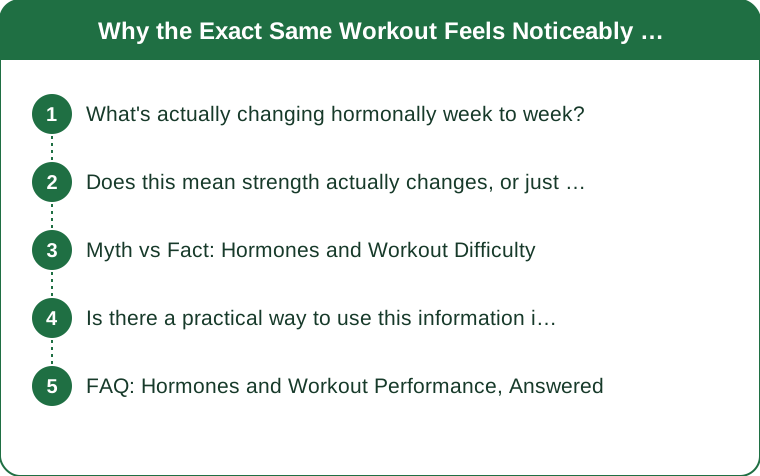
What’s actually changing hormonally week to week?
Estrogen and progesterone rise and fall in a predictable pattern across roughly a 28-day cycle. Estrogen, which tends to support strength and lower perceived exertion, generally rises through the follicular phase and peaks around ovulation. Progesterone rises through the luteal phase, and elevated progesterone is associated with higher body temperature and higher perceived effort at the same objective workload.
Does this mean strength actually changes, or just how hard it feels?
Both, to some degree — research shows some genuine performance variation across the cycle, though the more consistent and better-documented finding is a shift in perceived exertion, meaning the same objective workload can legitimately feel harder in the luteal phase even when actual strength output hasn’t dropped by much.

Myth vs Fact: Hormones and Workout Difficulty
Myth: A harder-feeling workout always means fitness has declined. Fact: Cycle-related hormonal shifts can explain a meaningful part of week-to-week perceived difficulty without any actual fitness loss.
Myth: Training should be identical every week regardless of cycle phase for consistency. Fact: Adjusting expectations (not necessarily the whole program) around known harder-feeling phases can prevent unnecessary frustration and discouragement.
Is there a practical way to use this information in training?
Tracking cycle phase alongside workout logs for a couple of months reveals whether an individual’s pattern matches the general trend — some people notice almost no difference, others notice a clear one — and that personal data point is more useful than a general rule applied without checking.
FAQ: Hormones and Workout Performance, Answered
Should workout intensity be deliberately reduced during the luteal phase?
Not necessarily — many people can train at full intensity throughout, but understanding that perceived effort may be higher helps interpret a tougher session accurately rather than as a fitness setback.
Does this pattern apply the same way to everyone?
No — individual variation is significant, and some people notice little to no cycle-related difference in workout difficulty.
Does hormonal birth control change this pattern?
Often yes, since hormonal contraceptives alter the natural fluctuation pattern, meaning cycle-difficulty correlation may look different or be less pronounced.
TL;DR:
- Estrogen and progesterone shift across the cycle in a way that affects perceived workout effort
- The luteal phase (after ovulation) is commonly associated with higher perceived exertion
- This reflects real physiology, not a lack of fitness or willpower
- Tracking personal patterns over a couple of months clarifies individual variation
A harder week doesn’t always mean something went wrong — sometimes it just means the hormonal backdrop of that particular week was different.
Keep Reading
This article is for general informational and styling purposes only. Fit, sizing, and product availability may vary.