Why Your Strength Gains Seem to Stall During the Luteal Phase (And What to Do Instead)
Quick Answer: Strength genuinely feels harder to access during the luteal phase (roughly days 15-28 of a typical cycle) because rising progesterone increases resting body temperature and can blunt neuromuscular recruitment — the fix isn’t pushing through it, it’s shifting to maintenance-intensity work and letting your follicular phase carry the progressive overload.
You hit a new squat PR two weeks ago and today the same weight feels 15 pounds heavier. That’s not a motivation problem — it’s a measurable shift in what your nervous system can access that week.

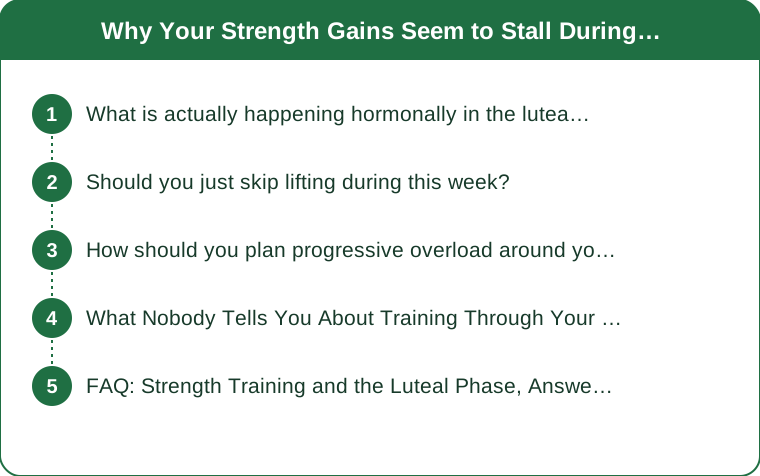
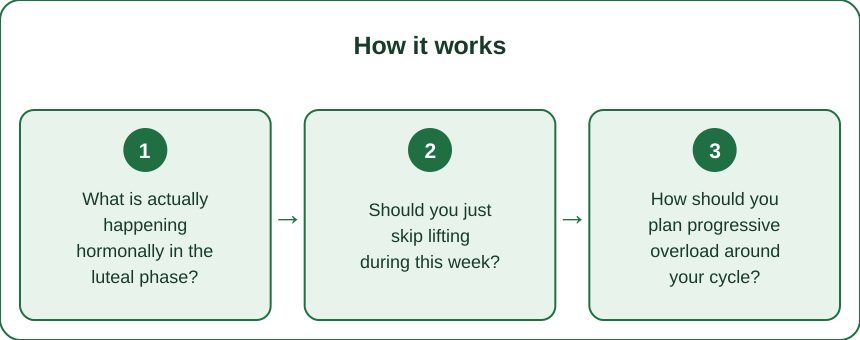
What is actually happening hormonally in the luteal phase?
After ovulation, progesterone rises sharply and estrogen dips, and progesterone has a mild sedative, heat-generating effect that raises your resting core temperature by roughly 0.3-0.5°C. This shift is associated with reduced neuromuscular efficiency — meaning the same weight recruits less muscle fiber than it did during the follicular phase.
This isn’t universal or identical for every cycle or every woman, but it’s consistent enough in research and lifter-reported data to plan around rather than fight.
Should you just skip lifting during this week?
No — skipping entirely wastes a week you can still use for maintenance volume, just not new personal records. Keep the same lifts and roughly the same reps, but drop load by 5-10% and let RPE (rate of perceived exertion) guide the exact number rather than the number on the plate from two weeks ago.
Think of it as holding the line rather than pushing forward — you’re preserving strength, not chasing new territory.

How should you plan progressive overload around your cycle?
Concentrate your heaviest attempts and PR pushes in the follicular phase (roughly days 1-14, especially the week right after your period ends), when estrogen is rising and neuromuscular performance research shows it’s typically most favorable. Treat the luteal phase as consolidation weeks in a longer program, not a separate mini-program.
Over a full training block, this means your progression curve looks like two steps up and one step of holding steady, rather than a flat monthly line — which is normal and still adds up to real strength gains.
What Nobody Tells You About Training Through Your Cycle
Nobody tells you that the ‘off’ week isn’t actually off — maintenance-intensity training during the luteal phase still preserves the strength adaptations from your PR week, so you’re not losing ground even when the bar feels heavier.
They also don’t tell you that sleep quality often drops in this phase too, which compounds the perceived-effort increase — so a slightly heavier plate might really be a slightly worse night’s sleep talking.
FAQ: Strength Training and the Luteal Phase, Answered
Is it normal for the same weight to feel harder some weeks?
Yes, this is one of the most consistently reported patterns among people who track training alongside their cycle, and it lines up with known hormonal shifts.
Should I track my cycle alongside my lifts?
It’s worth trying for 2-3 cycles — most people find the pattern repeats closely enough to plan heavy weeks in advance.
Does this apply if I’m on hormonal birth control?
The pattern is usually blunted or absent on combination birth control since it suppresses the natural hormone swing, though some formulations still produce a milder version of it.
TL;DR:
- Rising progesterone in the luteal phase measurably reduces neuromuscular efficiency, not motivation
- Drop load 5-10% and let RPE guide the exact number instead of chasing last cycle’s PR
- Schedule your heaviest attempts for the follicular phase (roughly days 1-14)
- A ‘maintenance’ week during luteal phase still protects the gains you already made
Training with your cycle instead of against it doesn’t slow your progress — it just spreads it out more honestly across the month.
Keep Reading
This article is for general informational and styling purposes only. Fit, sizing, and product availability may vary.