Why Caffeine Hits Differently Across Your Cycle
Quick Answer: Caffeine clearance slows in the luteal phase — the roughly two weeks after ovulation — because elevated progesterone and estrogen influence the liver enzyme that metabolizes it. Practically, the same dose stays in your system longer and hits harder. Combine that with luteal-phase sleep already being lighter and a slightly higher baseline heart rate, and the jitteriness has a straightforward explanation. Shifting your last cup earlier in the day usually helps more than cutting the amount.
Two identical mornings, two identical coffees, two completely different afternoons. One week it’s fine. The next week you’re wired at 11pm and your heart won’t settle.
You didn’t develop a sensitivity. Your clearance rate changed.

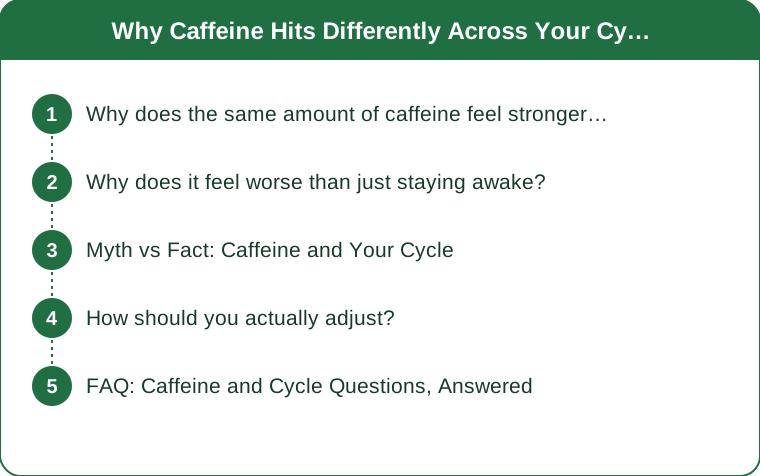
Why does the same amount of caffeine feel stronger some weeks?
Caffeine is metabolized primarily by a liver enzyme called CYP1A2, and how quickly that enzyme works determines how long caffeine stays active in your system.
Sex hormones influence that enzyme’s activity. During the luteal phase — after ovulation, roughly the second half of the cycle — both progesterone and estrogen are elevated, and caffeine clearance tends to slow. The same 200mg dose stays around longer, so the peak feels stronger and the tail extends later into the evening.
The magnitude varies quite a lot between individuals, which is part of why the effect gets dismissed. Some people notice nothing; others describe the difference as obvious enough to plan around. This is also why the effect is far more pronounced for people on hormonal contraception containing estrogen — caffeine clearance can slow considerably, which is a documented interaction and not a small one.
What this looks like in practice: the follicular phase (from your period through ovulation) is your normal baseline. The luteal phase is when the afternoon cup starts showing up at bedtime.
Why does it feel worse than just staying awake?
Because caffeine isn’t landing on an otherwise unchanged body. Three things stack in the luteal phase.
Sleep is already lighter. Sleep quality tends to decline in the luteal phase, with more awakenings and less deep sleep for many people — even before caffeine enters it. Slower caffeine clearance on top of already-fragile sleep is a compounding problem, not an additive one.
Resting heart rate runs higher. Core body temperature rises by a few tenths of a degree after ovulation, and resting heart rate typically ticks up a couple of beats. Caffeine raises it further. That’s the mechanism behind the wired, slightly racing feeling from a dose that was unremarkable two weeks earlier.
Anxiety sensitivity may be elevated. Many people report heightened anxiety in the late luteal phase. Caffeine is a well-known amplifier of anxious feelings at higher doses, so the same cup can land on a more reactive baseline.
So the experience — jittery, unable to settle, poor sleep, edgy — comes from caffeine hitting harder and the ground being less stable underneath it.

Myth vs Fact: Caffeine and Your Cycle
Myth: You should cut caffeine entirely in the luteal phase. Fact: For most people, timing does more than abstinence. Moving your last cup earlier addresses the sleep problem, which is where most of the downstream misery comes from — and abrupt withdrawal brings its own headaches and fatigue, which is a poor trade during the phase you already feel worse.
Myth: Caffeine causes period cramps. Fact: The evidence for caffeine causing cramps is weak. Caffeine can worsen breast tenderness for some people, and that association may be where the belief comes from. If you notice a clear personal pattern, act on it — just don’t assume it applies universally.
Myth: If you’re a habitual coffee drinker, you’re fully tolerant and this doesn’t apply. Fact: Tolerance develops to some effects, but the metabolic clearance rate is a separate mechanism. You can be well-adapted to your usual dose and still find it lingering longer in the luteal phase.
Myth: Switching to green tea solves it. Fact: It reduces the dose, which helps, but green tea still contains caffeine cleared by the same pathway. The L-theanine may smooth the edge somewhat. It’s a dose reduction with a nicer texture, not a different mechanism.
Myth: This is all in your head. Fact: Hormonal influence on caffeine clearance is measurable, and the interaction with estrogen-containing contraception is well enough established to appear in clinical references.
How should you actually adjust?
Timing first, dose second. That order matters.
Move your cutoff earlier in the luteal phase. If your usual cutoff is 2pm, try noon during the second half of your cycle. Caffeine’s half-life is roughly 5 hours normally and longer when clearance slows — so a 2pm cup can still have a meaningful amount active at bedtime during the luteal phase.
Keep the morning cup. Cutting the morning coffee costs you the benefit and doesn’t solve the sleep problem, since the morning dose was mostly cleared by evening anyway. The afternoon one is the one causing trouble.
Track it for two cycles before changing much. Note your caffeine time and amount, then rate your sleep and jitteriness. Two cycles is enough to see whether you’re one of the people who notices a large difference or one who doesn’t. Individual variation here is substantial and general advice is a poor substitute for your own data.
Adjust around training too. If you use caffeine pre-workout, an evening session in the luteal phase is where it’s most likely to cost you sleep. Consider shifting that session earlier, or dropping the pre-workout dose for evening training specifically.
Watch for hidden sources. Pre-workout formulas, dark chocolate, some teas, and certain pain relievers all contribute. The 2pm cup often isn’t the whole story.
This is general information, not medical advice. If you experience heart palpitations, persistent insomnia, or anxiety that interferes with your day, talk to a healthcare professional — and mention hormonal contraception if you use it, since it meaningfully affects caffeine metabolism.
FAQ: Caffeine and Cycle Questions, Answered
How do I know which phase I’m in?
The luteal phase runs from ovulation to the start of your period, typically about 12-14 days. If you track your cycle, it’s the second half. A rise in resting heart rate and basal body temperature on a wearable is a reasonable practical marker for most people.
Does this apply if I’m on hormonal birth control?
If your contraception contains estrogen, caffeine clearance can slow substantially and consistently rather than cyclically — so you may be running at the slower rate all month. Progestin-only methods work differently. Worth discussing with your prescriber if caffeine feels stronger than it used to.
What about perimenopause?
Hormone levels become less predictable, so the pattern is often less regular and harder to plan around. Many people notice increased caffeine sensitivity during this period, particularly regarding sleep and palpitations. Tracking becomes more useful than phase-based rules.
TL;DR:
- Caffeine clearance slows in the luteal phase because hormones influence the liver enzyme that metabolizes it.
- It compounds with luteal-phase sleep already being lighter and resting heart rate running higher.
- Estrogen-containing contraception slows clearance substantially, and consistently rather than cyclically.
- Fix timing before dose — move your cutoff earlier in the second half of your cycle and keep the morning cup.
- Track two cycles before changing much; individual variation is large.
If the pattern sounds familiar, note your caffeine timing alongside your sleep for the next two cycles. Most people find one specific cup is responsible, and moving it by two hours fixes the whole thing.
Keep Reading
This article is for general informational and styling purposes only. Fit, sizing, and product availability may vary.