Why Your Appetite Changes in the Week Before Your Period
Quick Answer: In the luteal phase, the roughly two weeks after ovulation, your resting metabolic rate rises by about 2 to 12 percent, meaning you genuinely need 100 to 300 extra calories a day. At the same time, progesterone reduces insulin sensitivity slightly and falling serotonin increases the pull toward carbohydrate specifically. So you are hungrier because you need more fuel, and you want carbohydrate specifically because of a neurotransmitter shift. Both are physiological. The productive response is to plan for the extra intake rather than to resist it.
The same week every month, the food you have been eating stops being enough, and what you want changes.
It is easy to read this as a discipline problem, particularly if the rest of the month feels effortless. It is mostly a metabolism and neurotransmitter problem, and the difference matters because the two call for opposite responses.

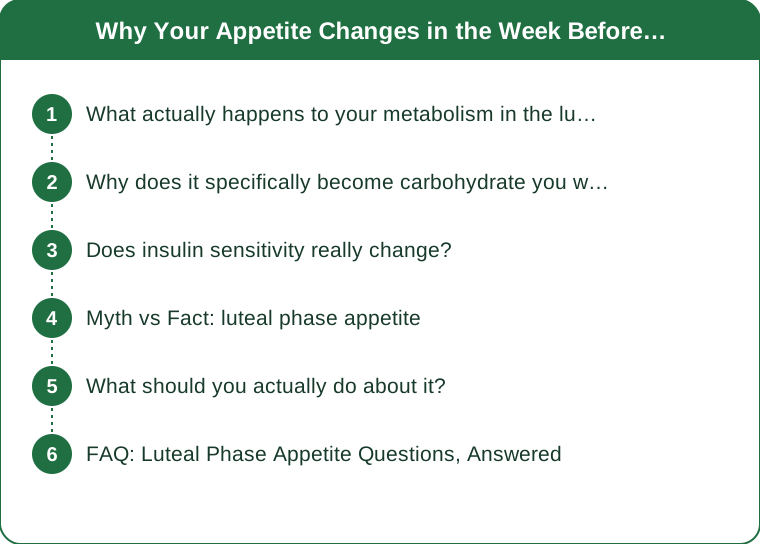
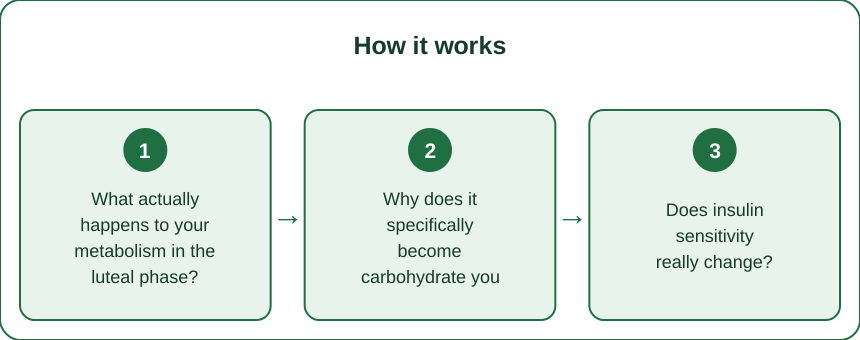
What actually happens to your metabolism in the luteal phase?
Your resting metabolic rate goes up, and the increase is measurable.
Studies using indirect calorimetry have found luteal-phase resting metabolic rate elevated by roughly 2 to 12 percent compared to the follicular phase. The range is wide because individual variation is large. For a woman with a resting rate around 1,400 calories, that is somewhere between 30 and 170 extra calories at rest, and more once you account for activity.
The likely mechanisms are progesterone’s thermogenic effect, which also raises basal body temperature by about 0.3 to 0.5 degrees Celsius, and elevated protein turnover.
Practically, most women need something in the range of 100 to 300 additional calories per day during this phase.
Here is the part that makes it feel like a failure: your hunger signalling is accurately reporting a real energy deficit. If you eat the same amount you ate two weeks ago, you are under-eating relative to need, and your body is correctly telling you so. Resisting that signal is resisting accurate information.
Why does it specifically become carbohydrate you want?
Because a different system is involved, and it is not the energy system.
Serotonin levels decline in the late luteal phase, tracking the fall in estrogen. Low serotonin is associated with low mood, irritability, and, relevantly, increased carbohydrate appetite.
The proposed mechanism is elegant: carbohydrate intake raises insulin, insulin clears most amino acids from the bloodstream but not tryptophan, so tryptophan’s relative concentration rises, more crosses into the brain, and serotonin synthesis increases. Eating carbohydrate genuinely produces a modest serotonin rise.
Which means the craving is not random. It is a reasonably targeted attempt to correct a neurotransmitter dip using the one lever available through food.
Why it tends to be sweet and starchy rather than any carbohydrate: faster-absorbing carbohydrate produces a larger and quicker insulin response, so the effect arrives sooner. Your system learned which foods work, and it is asking for those.
The catch: the effect is short-lived, and a large rapid rise is followed by a drop that can leave you feeling worse. This is why the craving often repeats an hour or two later, which is the part that feels like losing control.
Does insulin sensitivity really change?
Modestly, and it contributes.
Progesterone reduces insulin sensitivity somewhat in the luteal phase. The effect is small in most healthy women, but it is enough to change how you experience a given meal.
What it feels like in practice: blood sugar swings a bit more. A meal that held you for four hours in week one holds you for three in week three. The dip at the bottom of that swing produces hunger and, often, a sharper craving than the same dip would in the follicular phase.
This is where meal composition earns its place, and it is the one lever with a clear practical answer.
A meal built around protein, fiber, and fat produces a flatter curve. A meal that is largely fast carbohydrate produces a steeper one, and in a phase where you are already less insulin sensitive and already serotonin-dipped, a steep curve is the version that leads to the two-hour repeat.
This is not an argument against eating carbohydrate in the luteal phase. It is an argument for eating it alongside other things.

Myth vs Fact: luteal phase appetite
Myth: PMS cravings are purely psychological. Fact: resting metabolic rate is measurably elevated, serotonin measurably falls, and insulin sensitivity measurably decreases. All three have direct appetite consequences.
Myth: you should resist the extra hunger to stay on track. Fact: under-eating relative to a genuinely elevated need tends to produce a larger rebound later in the phase. Meeting the need with planned food produces a much more stable pattern than resisting and then over-correcting.
Myth: the weight gain in that week is fat. Fact: luteal phase weight increases are dominated by fluid retention, driven by hormonal effects on sodium handling. It is typically 0.5 to 2kg and resolves within a few days of your period starting.
Myth: chocolate cravings mean you are low in magnesium. Fact: this is a persistent claim with weak evidence. Chocolate is high in sugar and fat and has strong learned associations with comfort, which explains the craving without needing a deficiency.
Myth: this affects all women the same way. Fact: the metabolic rate increase ranges from about 2 to 12 percent. Some women notice nothing. Others need 300 extra calories. Both are normal.
What should you actually do about it?
Plan for it rather than fight it. That is the whole strategy, and it works better than any of the alternatives.
Add the calories deliberately, in food you chose. If you need 200 extra, decide in advance what those are: a larger breakfast, an afternoon snack with protein, a bigger dinner portion. Planned extra food is far more satisfying than unplanned extra food, and it prevents the pattern where you resist all day and then eat past the point of comfort in the evening.
Front-load protein. 25 to 30g at breakfast blunts the rest of the day’s swings more than the same protein later. This is one of the more reliable practical findings in appetite research.
Do not eat carbohydrate alone in this phase. Pair it with protein or fat. You still get the serotonin effect, just with a flatter curve and without the two-hour repeat.
Track which cycle day it starts for you. Most women have a consistent personal pattern, often day 20 to 24. Knowing your day means you can plan the week rather than being surprised by it every month.
Adjust training expectations rather than intake. If something has to give in the late luteal phase, make it training intensity rather than food. Under-fueling this phase is what turns a manageable week into a difficult one.
When it is worth a conversation with a clinician: if mood changes are severe enough to disrupt work or relationships, that may be PMDD rather than typical PMS and it is treatable. If the appetite change comes with cycles that have become irregular or absent, that combination is worth investigating rather than managing.
This is general information, not medical advice.
FAQ: Luteal Phase Appetite Questions, Answered
How many extra calories do I actually need before my period?
Most women need roughly 100 to 300 additional calories per day in the luteal phase, driven by a 2 to 12 percent rise in resting metabolic rate. Individual variation is large.
Why do I specifically crave sugar and carbs?
Serotonin falls in the late luteal phase, and carbohydrate intake produces a modest serotonin rise through a tryptophan mechanism. The craving is a targeted attempt to correct that dip.
Is the weight gain before my period real fat?
No. It is predominantly fluid retention, typically 0.5 to 2kg, and it resolves within a few days of your period beginning.
TL;DR:
- Resting metabolic rate rises 2 to 12 percent in the luteal phase, so you genuinely need 100 to 300 more calories a day.
- Falling serotonin drives carbohydrate cravings specifically, through a real tryptophan and insulin mechanism.
- Slightly reduced insulin sensitivity makes blood sugar swings sharper, which is why the craving repeats.
- Plan the extra intake, front-load protein, and never eat carbohydrate alone in this phase.
- The weight change is fluid, not fat, and it clears within days.
Your appetite is reporting accurate information about a body that needs more this week. The productive move is to answer it on purpose.
Keep Reading
This article is for general informational and styling purposes only. Fit, sizing, and product availability may vary.