Why Losing Weight Quickly Changes Your Cycle
Quick Answer: Your reproductive system reads energy availability, not weight. A large or fast calorie deficit signals scarcity, which suppresses the hormonal pulses that drive ovulation - producing longer cycles, lighter periods, or missed ones. It usually reverses when energy availability is restored, often within one to three cycles. Losing weight more slowly, eating enough around training, and not stacking a hard deficit on top of hard training prevents most of it.
This is a signal worth listening to rather than pushing through.

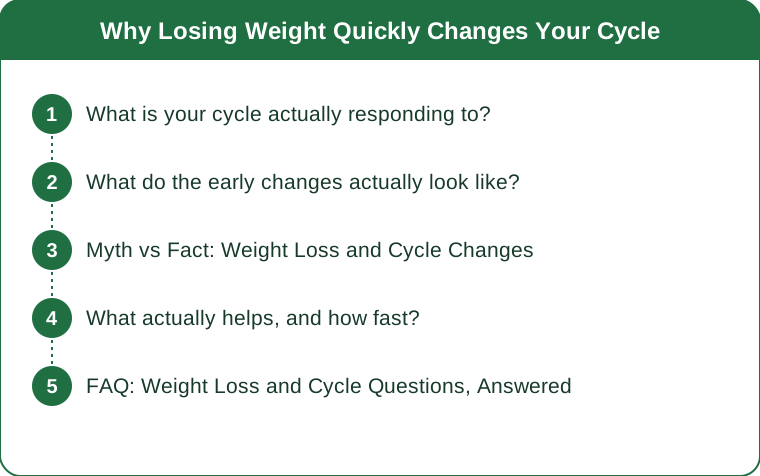
What is your cycle actually responding to?
Energy availability - which is not the same as your weight, and not the same as how much you eat.
Energy availability is roughly the energy left over after exercise, relative to your lean mass. Someone eating 2,000 calories and burning 300 in training has far more available than someone eating 2,000 and burning 800, even though the intake is identical. This is why athletes at a perfectly normal weight can lose their cycle, and why the scale is a poor guide to whether there is a problem.
The control chain runs from the hypothalamus. It releases GnRH in pulses, which drives LH and FSH from the pituitary, which drive the ovarian cycle. Those pulses are exquisitely sensitive to signals about energy status - circulating leptin, which falls with fat loss and with acute underfeeding, along with insulin, ghrelin, and thyroid hormones.
When those signals suggest scarcity, the hypothalamus slows the pulses. Slower or less regular pulses mean the follicle does not mature on schedule, ovulation is delayed or does not happen, and the cycle lengthens or stops. The clinical name is functional hypothalamic amenorrhea when periods stop entirely, and there is a whole spectrum before that point.
The key insight: this is a deliberate, adaptive response, not a malfunction. Reproduction is metabolically expensive, and a system that reads scarcity postpones it. Understanding it that way changes the response - the fix is to change the signal, not to override it.
What do the early changes actually look like?
The full loss of a period is the end of a progression, not the start. The earlier signs are more common and easier to miss.
In roughly the order they appear:
- Cycles get longer. A reliable 28-day cycle becomes 32, then 38. This is a shortened or absent luteal phase and it is often the first sign.
- Periods get lighter. Noticeably less flow, fewer days.
- PMS symptoms fade. This gets celebrated rather than noticed, but a sudden disappearance of premenstrual symptoms can indicate that ovulation is not happening.
- Basal temperature stops showing a shift. If you track it, the post-ovulation rise disappearing is a fairly direct signal.
- Cycles become unpredictable, then skipped entirely.
Alongside those, the broader signs of low energy availability:
- Feeling cold constantly, particularly hands and feet
- Sleep getting worse rather than better despite fatigue
- Resting heart rate dropping unusually low, or heart rate variability behaving oddly
- Training performance stalling or declining despite consistent work
- Low mood, irritability, and preoccupation with food
- Hair shedding more than usual, and nails becoming brittle
- Frequent minor illness or slow-healing niggles
Three or more of these together, alongside a cycle change during a diet, is a clear picture. It is not a reason to panic, and it is a reason to change something.

Myth vs Fact: Weight Loss and Cycle Changes
Myth: This only happens if you are underweight. Fact: It happens at any weight, including in people carrying more body fat than average. The trigger is the size and speed of the deficit relative to your needs, not the number on the scale. Someone losing quickly from a higher starting weight can absolutely produce this.
Myth: Missing periods while dieting is a sign it is working. Fact: It is a sign the deficit is too aggressive. It also comes with costs that are not visible - bone density declines during extended amenorrhea, and the risk of stress fractures rises. Losing more slowly reaches the same destination without that bill.
Myth: Going on hormonal birth control fixes it. Fact: It produces a withdrawal bleed, which masks the signal without addressing the underlying energy deficit. The bone density risk continues. There are good reasons to take hormonal contraception; treating diet-induced cycle loss is not one of them, and this is a conversation to have with a doctor rather than a decision to make from an article.
Myth: It will come back on its own once you reach your goal weight. Fact: Frequently yes, but recovery is often slower than the loss was, and the longer it goes on the longer it tends to take. Waiting it out is a worse strategy than adjusting now.
Myth: More cardio and less food will restart it. Fact: The exact opposite of what the physiology calls for. The signal being read is scarcity, and adding training while reducing intake makes the signal stronger.
What actually helps, and how fast?
The general shape is straightforward, though it takes patience.
Reduce the size of the deficit. A rate of loss around 0.5 to 1 percent of body weight per week is generally sustainable; much faster than that is where the problems concentrate. Slowing to the lower end of that range, or taking a maintenance break of a few weeks, is frequently enough on its own.
Eat around training specifically. Much of the low energy availability problem is not total intake but timing - training hard in a fasted state and eating most calories in the evening produces long windows of very low availability even when the daily total looks adequate. Carbohydrate before and after training addresses this directly.
Do not cut carbohydrate to the floor. Very low carbohydrate intake affects the thyroid and leptin signalling that this system reads. This is one of the more consistent findings in the area and one of the most frequently ignored.
Reduce training volume temporarily, particularly steady-state cardio. This raises energy availability without requiring you to eat more, which some people find easier as a starting point.
Take rest days seriously, and address sleep and psychological stress, both of which feed into the same hypothalamic signalling.
Timeline: many people see cycles return within one to three months of restoring energy availability. Some take longer, particularly after extended amenorrhea. Recovery is rarely instant and the absence of an immediate change does not mean it is not working.
When to see a doctor: if periods have been absent for three months or more, if cycle changes come with other symptoms, or if you have adjusted intake and training for three months without improvement. Amenorrhea has other causes - thyroid disorders, PCOS, elevated prolactin, and others - that need ruling out, and bone density may be worth assessing. This is general information, not medical advice, and this is a situation where a real assessment is genuinely worth having.
FAQ: Weight Loss and Cycle Questions, Answered
How fast is too fast to lose weight?
As a general guide, more than about 1 percent of body weight per week is where problems become more likely, and the risk rises the leaner you already are. Someone with more to lose can safely lose faster at the start than they can later.
Can this happen from exercise alone, without dieting?
Yes. Increasing training volume without increasing intake produces the same low energy availability. This is the classic athlete presentation and it is why the scale is unhelpful as a warning system.
Does it affect fertility permanently?
For most people, no - fertility typically returns with the cycle. Prolonged amenorrhea is worth medical attention for exactly this reason, and if you are trying to conceive it is a conversation to have with a doctor sooner rather than later.
I track my cycle with an app. What should I actually watch?
Cycle length trend rather than any single cycle, and flow. A cycle drifting from 28 to 34 to 40 days over three months during a diet is the pattern to act on, and it is much more informative than one late period.
TL;DR:
- Your cycle responds to energy availability, not weight - which is why this happens at any body size.
- The hypothalamus slows the hormonal pulses that drive ovulation when it reads scarcity. It is adaptive, not broken.
- Early signs are longer cycles, lighter periods, and PMS disappearing - well before a period is actually missed.
- Fixes: slow the rate of loss, eat around training, keep carbohydrate reasonable, and reduce volume temporarily.
- Absent periods for three months or more warrants a doctor’s assessment - other causes exist, and bone density matters.
A cycle change during a hard diet is information. Slowing down now costs less than recovering later.
Keep Reading
This article is for general informational and styling purposes only. Fit, sizing, and product availability may vary.