Does Travel Actually Throw Off Your Cycle, or Is That a Myth?
Quick Answer: Yes, travel can genuinely shift cycle timing. The main mechanisms are disrupted circadian rhythm from crossing time zones, physical and psychological stress affecting the hypothalamic signals that drive ovulation, and changes in sleep, activity, and eating. A cycle shifted by a few days around a trip is common and self-resolving. Cycles that remain irregular for three or more months are worth discussing with a healthcare professional.
You get back from ten days away and your period is five days late. You are fairly sure it is the trip, but you would like to know whether that is real or just something people say.

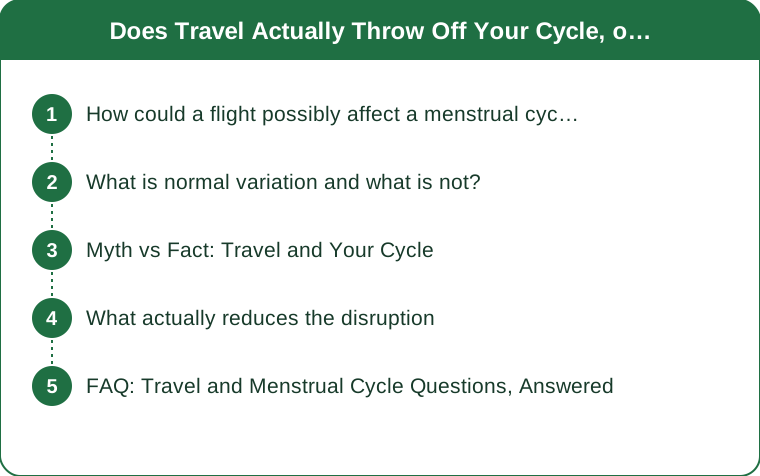
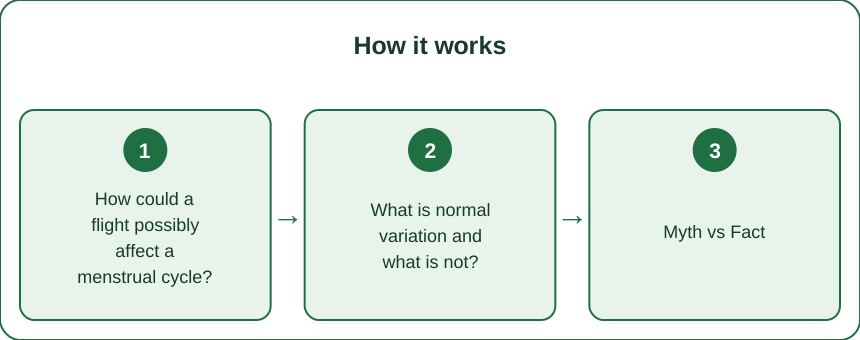
How could a flight possibly affect a menstrual cycle?
Through the same control system that governs sleep, appetite, and stress response.
The cycle is driven from the brain, not the ovaries. The hypothalamus releases GnRH in a pulsatile pattern, which drives LH and FSH release from the pituitary, which in turn drives ovarian function. That pulse pattern is sensitive to sleep, stress, energy availability, and circadian signals - all of which travel disrupts.
Circadian disruption is the most direct route. The hypothalamus houses the body’s master clock, and crossing multiple time zones desynchronises it. Since the same region governs reproductive hormone signalling, disruption in one can affect the other.
Stress affects the same axis. Both physical stress - poor sleep, long journeys, unfamiliar food - and psychological stress increase cortisol, which can suppress GnRH pulsatility. If this happens before ovulation, ovulation is delayed and the whole cycle lengthens.
Energy availability matters too. Travel often means irregular eating, more activity than usual on sightseeing days, or considerably less on work trips. Low energy availability is a well-documented suppressor of reproductive hormone signalling.
The key insight about timing: the luteal phase, after ovulation, is relatively fixed at around 12-14 days. The follicular phase, before ovulation, is the variable one. So a disruption delays ovulation and the period arrives late - it does not usually shorten the cycle.
What is normal variation and what is not?
Most travel-related change falls comfortably inside normal.
Cycle length naturally varies between cycles. Variation of a few days from one cycle to the next is ordinary in people with regular cycles, and cycles anywhere from roughly 21 to 35 days are generally considered within the normal range.
A single delayed or early period after a trip is unremarkable, particularly after long-haul travel, a stressful trip, or one involving significant sleep disruption.
One skipped period after a major disruption also happens and usually resolves without intervention.
What warrants attention: three or more consecutive months of irregular cycles, cycles consistently shorter than 21 or longer than 35 days, bleeding between periods, unusually heavy bleeding, or periods stopping for three months or more without an obvious explanation.
Pregnancy is worth ruling out first whenever a period is late and there is any possibility, regardless of how convincing the travel explanation is. It is the single most common cause of a missed period and the easiest to check.
And a note on direction of travel: some research suggests eastward travel, which shortens the day and is generally harder to adapt to, may be more disruptive than westward. The evidence is not strong enough to plan around, but it matches most people’s experience of jet lag.
This is general information, not medical advice. Persistent cycle changes, missed periods, or any new or unusual bleeding should be assessed by a healthcare professional.
Myth vs Fact: Travel and Your Cycle
Myth: Cabin pressure or altitude causes period changes. Fact: Commercial cabin pressurisation does not meaningfully affect reproductive hormones. The disruption comes from time zone shifts, sleep loss, and stress - the same things that would affect you on a long overnight drive.
Myth: Travel makes your period come early. Fact: Delay is far more common, because disruption typically postpones ovulation and the luteal phase length is relatively fixed. A cycle that ends up shorter than usual is possible but less typical.
Myth: Your cycle syncs with other women you travel with. Fact: The evidence for menstrual synchrony has largely not held up under scrutiny, and the apparent effect is well explained by chance overlap between cycles of differing lengths. Shared travel disruption affecting several people similarly is a more plausible explanation for what people notice.
Myth: Time zone changes only matter if you cross many of them. Fact: Even a two- or three-hour shift disrupts sleep timing meaningfully for some people, and sleep disruption is one of the more direct routes to cycle change. Short-haul frequent travel can be as disruptive as an occasional long haul.
Myth: If travel delayed it once, it always will. Fact: Response varies between people and between trips, depending on how much sleep, stress, and eating were actually disrupted. A relaxing trip with good sleep may not shift anything at all.
What actually reduces the disruption
The interventions that help jet lag generally help here too, because the mechanism overlaps.
Prioritise sleep timing over sleep duration on arrival. Getting onto local time quickly matters more than total hours in the first few days, and morning daylight exposure is the strongest tool available for shifting your clock.
Eat at local meal times from day one. Meal timing is a secondary circadian cue and helps the adjustment, and it also prevents the erratic eating that reduces energy availability.
Do not under-eat on active trips. Sightseeing days often involve far more walking than a normal day alongside irregular meals. That combination is a textbook low energy availability scenario, and it is a plausible contributor to cycle disruption on holidays specifically.
Manage caffeine and alcohol deliberately. Both worsen sleep quality at exactly the point where sleep quality matters most, and both tend to increase on trips.
Track rather than worry. A cycle tracking app or a note in a calendar turns “my cycle is all over the place” into a specific record, which is far more useful if you do end up seeing a healthcare professional.
Carry supplies regardless of your predicted date. The whole point is that timing becomes less predictable around travel, and being caught out in an unfamiliar place is a small, avoidable problem.
And if you take hormonal contraception, discuss time zones with a pharmacist or prescriber before you go. Timing rules differ between methods, and getting the schedule right across time zones is a practical question worth asking rather than guessing.
FAQ: Travel and Menstrual Cycle Questions, Answered
Can travel really delay your period?
Yes. Circadian disruption, sleep loss, stress, and irregular eating can all affect the hypothalamic signalling that triggers ovulation. Delayed ovulation lengthens the cycle, so the period arrives late.
How late is too late after a trip?
A few days is unremarkable, and a single skipped cycle after a significant disruption is common. If you have any possibility of pregnancy, test first. Three or more consecutive irregular months warrants a conversation with a healthcare professional.
Does the direction of travel matter?
Possibly. Eastward travel shortens the day and is generally harder to adapt to, and some evidence suggests it may be more disruptive. The difference is not large enough to change travel plans over.
Why does my period come early sometimes when I travel?
Less commonly, but it happens. The luteal phase is relatively fixed while the follicular phase varies, so most disruption delays rather than advances. Early bleeding that is unusual for you, or bleeding between periods, is worth mentioning to a clinician.
Should I be worried if my cycle is irregular after a big trip?
One irregular cycle after significant disruption is expected. Persistent irregularity over three or more months, cycles outside the 21-35 day range, or periods stopping for three months or more should be assessed rather than attributed to the trip.
TL;DR:
- The cycle is controlled from the hypothalamus, which is also where circadian rhythm and stress response live - so travel has a genuine route in.
- Disruption usually delays ovulation, which lengthens the cycle; the luteal phase stays roughly fixed.
- A few days’ shift or one skipped cycle after a big trip is common and self-resolving.
- Morning daylight, local meal times, and eating enough on active days reduce the disruption.
- Three or more irregular months, or any unusual bleeding, deserves a professional opinion rather than a travel explanation.
It is not in your head, and it is not the cabin pressure. It is your body clock, your sleep, and ten days of eating whenever you got the chance.
Keep Reading
This article is for general informational and styling purposes only. Fit, sizing, and product availability may vary.