Does Skipping Breakfast Actually Affect Your Hormones?
Quick Answer: For most people, skipping breakfast does not disrupt hormones in any meaningful or lasting way. Where it does matter is at the margins: women in a significant energy deficit, those training hard in a fasted state, anyone with a history of disordered eating, and people already under high stress load. The hormonal effect is driven far more by total daily energy availability than by meal timing itself.
The question is rarely breakfast. It is almost always whether you are eating enough across the day.

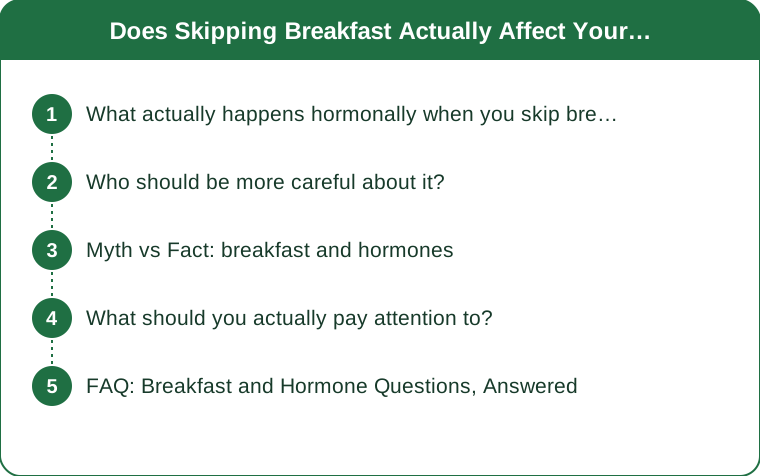
What actually happens hormonally when you skip breakfast?
Several things shift acutely, and most of them are normal regulation rather than disruption.
Cortisol. Cortisol rises naturally in the morning as part of the cortisol awakening response, peaking roughly 30 to 45 minutes after waking regardless of whether you eat. Eating does modulate it somewhat, and prolonged fasting extends the elevated period slightly. This is normal physiological function, not a malfunction, and the daily fluctuation is far smaller than the effect of chronic stress or poor sleep.
Insulin and glucose. Skipping breakfast means insulin stays low longer, which is unremarkable. Some studies find that habitual breakfast skippers show a larger glucose response to lunch. Whether that matters clinically for a metabolically healthy person is not settled.
Ghrelin and leptin. Ghrelin, the hunger signal, rises on a learned schedule around habitual meal times. If you normally eat at 8am and do not, ghrelin peaks and then subsides. Over a couple of weeks it re-patterns to your new schedule, which is why the first week of skipping breakfast is much harder than the third.
Thyroid hormones. T3 can decline in response to sustained energy deficit. This is a response to insufficient total intake rather than to meal timing, and it does not happen from moving breakfast to noon while eating the same amount.
The pattern in all of this: short-term timing shifts produce short-term signal shifts. The hormonal changes that actually matter are driven by chronic energy availability, not by the clock.
Who should be more careful about it?
Four groups where the answer genuinely differs.
Anyone in a meaningful energy deficit. Low energy availability — not eating enough to cover training plus basic function — is the mechanism behind menstrual cycle disruption, reduced bone density and thyroid downregulation in active women. Skipping breakfast is not the cause; it is a common route to under-eating across the day, because a missed meal often is not made up later.
Women training hard, particularly fasted. Research on fasted training in women is less extensive than in men, and some evidence suggests women may be more sensitive to the hormonal effects of energy restriction combined with high training load. The practical version: if you train hard in the morning, eating something beforehand or promptly afterwards is the lower-risk choice.
Anyone with a history of disordered eating. Structured restriction of any kind, including intermittent fasting, carries genuine risk of triggering restrictive patterns. This is not a hormonal argument, it is a more important one, and it warrants a conversation with a clinician rather than an article.
People with high chronic stress or poor sleep. Both raise cortisol independently. Adding a prolonged morning fast on top of an already elevated stress load is a stack rather than a single variable, and this is where people most often report feeling genuinely worse.
Pregnancy, breastfeeding, diabetes and thyroid conditions all change the calculation entirely and are clinician territory. This is general information, not medical advice.

Myth vs Fact: breakfast and hormones
Myth: Skipping breakfast spikes cortisol and wrecks your hormones.
Fact: Morning cortisol rises whether you eat or not — it is what wakes you up. Fasting modestly extends the elevated window. The magnitude is small compared with sleep deprivation, chronic stress or a large energy deficit.
Myth: Women should never fast.
Fact: Too broad. The evidence base in women is thinner and there are reasons for caution in specific circumstances, but healthy women who eat adequately across the day generally do fine with a later first meal. The concern attaches to energy deficit, not to timing itself.
Myth: Breakfast boosts metabolism.
Fact: The thermic effect of food is proportional to what you eat, not when. Total daily intake determines total thermic effect. Eating at 7am rather than noon does not change daily energy expenditure meaningfully.
Myth: Skipping breakfast causes weight gain.
Fact: Observational studies find associations, but breakfast skippers differ in many other ways — sleep, activity, alcohol, overall diet quality. Controlled trials that hold calories constant generally find no independent effect of breakfast on weight.
Myth: If you feel fine, there is no hormonal cost.
Fact: Not quite. Menstrual cycle changes are the most reliable early signal of insufficient energy availability, and they can appear before you feel bad. A cycle that becomes irregular, lighter or absent after a change in eating pattern is worth taking seriously and worth discussing with a clinician.
What should you actually pay attention to?
Five signals, and none of them is a hormone panel.
1. Your menstrual cycle. The most useful hormonal feedback available and the cheapest. Changes in cycle length, flow or regularity following a change in eating pattern are meaningful information. Track it.
2. Whether you make the calories up. The practical question is not whether you skipped breakfast but whether your total daily intake stayed adequate. If lunch and dinner did not grow, you are running a deficit, and that deficit is the actual variable.
3. Training quality. Persistent flat sessions, stalled progress and a subjective sense that everything is harder are early signals of under-fueling, and they usually show up before any lab value does.
4. Sleep and mood. Under-fueling frequently shows up as poor sleep, early waking, low mood and irritability. If a new eating pattern coincides with these, the pattern is a reasonable suspect.
5. Whether the pattern is chosen or compelled. A meaningful distinction: skipping breakfast because you genuinely are not hungry is different from skipping it because you are anxious about eating. The second is worth attention regardless of any hormonal consideration.
Where a breakfast habit is genuinely useful: if you train in the morning, if you are pregnant or breastfeeding, if you have blood sugar management needs, if you struggle to hit adequate protein across the day, or if your cycle changed after you stopped eating it. Otherwise, the timing is far less important than the total.
FAQ: Breakfast and Hormone Questions, Answered
Does coffee break a fast in a way that affects hormones?
Black coffee has negligible caloric impact. Caffeine does raise cortisol somewhat, particularly in people who do not habitually consume it, and it does so whether or not you have eaten. If you are worried about morning cortisol, the coffee is a bigger variable than the missed meal.
I feel shaky and irritable if I skip breakfast. Is that hormonal?
Partly, and it also reflects habit. Ghrelin peaks at learned meal times and blood glucose dips are real. Most people who transition deliberately find it settles within one to three weeks. If it does not settle, or if you get genuinely symptomatic — sweating, confusion, faintness — that warrants a medical conversation rather than persistence.
What is the minimum reasonable breakfast if I do not want a full meal?
Something with protein: Greek yogurt, eggs, a protein shake, cottage cheese. Roughly 20 to 30 grams of protein does more for satiety and for hitting daily protein targets than a larger carbohydrate-only breakfast.
Should I eat before a morning workout?
For easy sessions under an hour, fasted is fine for most people. For hard or long sessions, something small beforehand — a banana, toast, a small shake — improves quality and reduces the chance of finishing the day in a deficit you never make up.
TL;DR:
- Morning cortisol rises whether you eat or not; skipping breakfast extends it modestly and matters far less than sleep or chronic stress.
- The hormonal risk attaches to total energy deficit, not to meal timing.
- Be more cautious if you train hard fasted, are already under-eating, have high stress, or have a history of disordered eating.
- Track your menstrual cycle — it is the most useful early signal available.
- If you skip breakfast, check that lunch and dinner actually got bigger.
Breakfast is not a hormone switch. Eating enough across the whole day is, and that is the question worth asking.
Keep Reading
This article is for general informational and styling purposes only. Fit, sizing, and product availability may vary.