Your Body Temperature Changes Across Your Cycle. Here Is What That Means for Training in Heat
Quick Answer: After ovulation, your resting core temperature rises by roughly 0.3 to 0.5C and stays elevated until your period starts. That sounds trivial and is not - it means you begin every luteal-phase workout with less thermal headroom, you start sweating at a higher temperature, and heat feels harder because it genuinely is. Expect hot-weather sessions in the two weeks before your period to feel noticeably tougher at the same effort, and plan hydration and intensity accordingly rather than concluding you have lost fitness.
This is not a small effect, and it is one of the least discussed practical realities of training as a woman in summer.

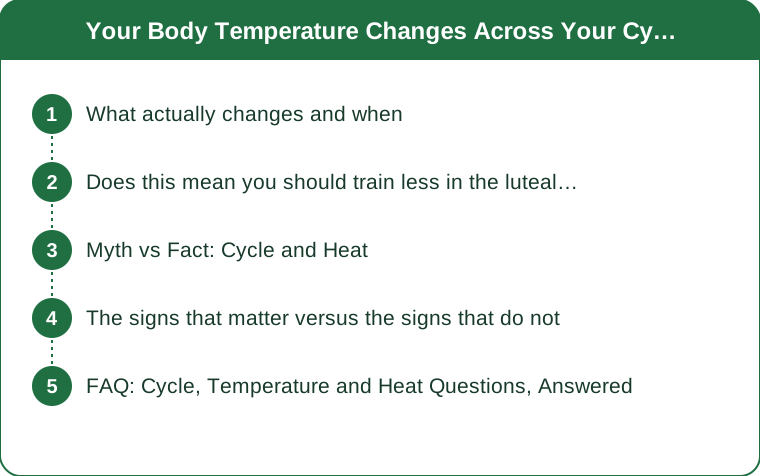
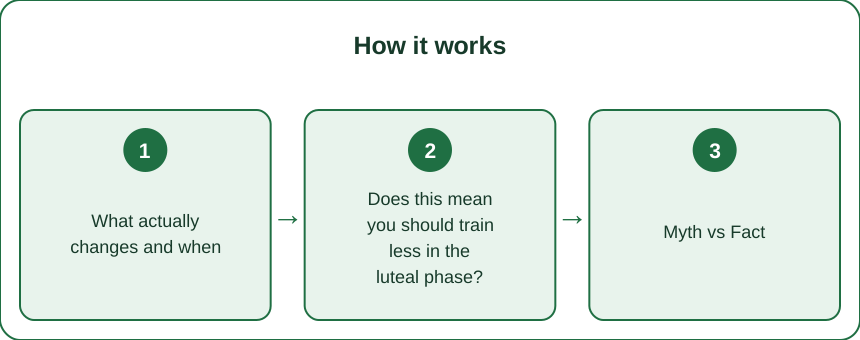
What actually changes and when
The temperature shift is one of the most reliably measured things in the whole cycle, which is why it has been used to track ovulation for decades.
The follicular phase, from the start of your period through ovulation, runs at your lower baseline temperature. This is your best thermal window - you have the most room before you reach the temperature at which performance starts degrading.
Ovulation is followed within a day or so by a rise of roughly 0.3 to 0.5C, driven mainly by progesterone.
The luteal phase, the roughly two weeks before your period, holds that elevated temperature the whole way through. It drops back sharply as your period begins.
What the elevated temperature actually costs you:
- Less headroom. You start closer to the ceiling at which heat becomes limiting
- A higher sweating threshold. Progesterone raises the core temperature at which sweating and skin blood flow kick in, so your cooling system starts later than it does in the follicular phase
- Higher perceived effort in heat at identical work rates
- Higher heart rate at the same pace, often by a few beats, partly from the temperature and partly from associated changes in blood volume
The practical version: a 28C run that felt fine three weeks ago can feel genuinely hard now, at the same pace, with no change in fitness. That is not in your head.
Does this mean you should train less in the luteal phase?
No - and the over-correction is its own problem.
What the evidence broadly supports: the cycle affects performance modestly on average, with large individual variation, and heat tolerance is one of the areas where the effect is most consistent. Strength and general training capacity are far less affected than popular accounts suggest.
What changes is the environment, not the training. The same session indoors in air conditioning may feel completely normal. It is the combination of the luteal phase and heat that stacks, not the phase alone.
Practical adjustments that are worth making:
- Move hard outdoor sessions earlier in the day during the two weeks before your period, especially in summer
- Extend warm-ups slightly and expect a longer settle into a comfortable rhythm
- Increase fluid and sodium intake, since progesterone also affects fluid balance and sodium handling, and the sweat you lose in this phase is more costly
- Use effort rather than pace as the target in hot outdoor sessions - your heart rate and perceived effort will both read higher at the same output
- Do not reschedule your whole life around it. For most people this is a matter of adjusting one or two sessions, not restructuring a training block
Track before you conclude anything. Individual variation here is enormous - some people notice this strongly and others genuinely do not - and three months of simple notes about how hot sessions felt will tell you more about your own pattern than any general rule.
Myth vs Fact: Cycle and Heat
Myth: The temperature change is too small to matter. Fact: A 0.3 to 0.5C shift in starting core temperature is meaningful when you are working in heat, because the gap between your baseline and your limit is not large. In cool conditions it barely registers, which is why the effect seems inconsistent until you separate hot sessions from cool ones.
Myth: You should avoid hard training in the luteal phase. Fact: There is no good reason to. The evidence for large phase-based performance differences is weaker than the popular narrative. Adjust for heat specifically; do not downgrade the whole fortnight.
Myth: Hormonal contraception makes this irrelevant. Fact: It changes the pattern rather than removing it. Combined hormonal contraception flattens the natural temperature swing but introduces its own pattern, often with a smaller elevation. If you are on hormonal contraception and still notice a cycle in how heat feels, that is plausible rather than imaginary.
Myth: Feeling hot means you are dehydrated. Fact: Both can be true at once, and dehydration definitely makes it worse. But in the luteal phase you can be perfectly hydrated and still be starting the session warmer.
The signs that matter versus the signs that do not
There is a line between this being an interesting physiological quirk and being a safety issue, and it is worth knowing where it sits.
Normal, expected, and not a concern:
- Feeling hotter and sweating more in hot sessions before your period
- A few extra beats of heart rate at the same pace
- Higher perceived effort in heat, lower motivation for outdoor sessions
- Needing more fluid than the same session required two weeks ago
Signals to stop the session immediately, in any phase:
- Stopping sweating while still working in heat
- Confusion, disorientation, or difficulty with coordination
- Nausea combined with headache and a rapid pulse
- Skin that is hot and dry rather than hot and wet
Those are heat illness signals and they are not cycle-related - they are emergencies at any point of the month. Get out of the heat, cool actively, and get help. This is general information, not medical advice, and anything that looks like heat illness should be assessed by a professional.
Worth raising with a doctor rather than training around: cycles that suddenly become much more disruptive than they used to be, temperature patterns that vanish entirely, or heat intolerance that is new and is not explained by the weather. Thyroid function and iron status both affect heat tolerance and both are common and checkable.
FAQ: Cycle, Temperature and Heat Questions, Answered
How do I know which phase I am actually in?
Counting from the first day of your period gives a reasonable estimate, but cycle length varies. Basal body temperature taken at the same time each morning before getting up shows the post-ovulation rise clearly after a couple of months of data, and most wearables now estimate it reasonably well from skin temperature.
Should I use my wearable temperature data for this?
As a pattern tracker, yes - the trend across weeks is genuinely useful. As an absolute measurement, no. Skin temperature is affected by room temperature, bedding, and alcohol, so a single night means very little while a month of nights means quite a lot.
Does heat acclimation work differently across the cycle?
The acclimation process itself works normally. What differs is where you start each session from, so acclimating during summer while in the luteal phase simply means the sessions feel harder for the same adaptation. There is no reason to time an acclimation block around your cycle.
TL;DR:
- Core temperature rises 0.3 to 0.5C after ovulation and stays up until your period starts
- That means less thermal headroom and a later sweating response - heat genuinely is harder in the luteal phase
- Adjust hot outdoor sessions, not your whole training block: earlier timing, more fluid and sodium, effort-based targets
- Individual variation is large - track three months of your own hot sessions before drawing conclusions
- Stopping sweating, confusion, or hot dry skin are heat illness signals in any phase and need immediate action
If summer sessions have felt inconsistent in a way that did not match your training, check the dates against your cycle. The pattern usually shows up within two months, and knowing it exists is most of the benefit.
Keep Reading
This article is for general informational and styling purposes only. Fit, sizing, and product availability may vary.